


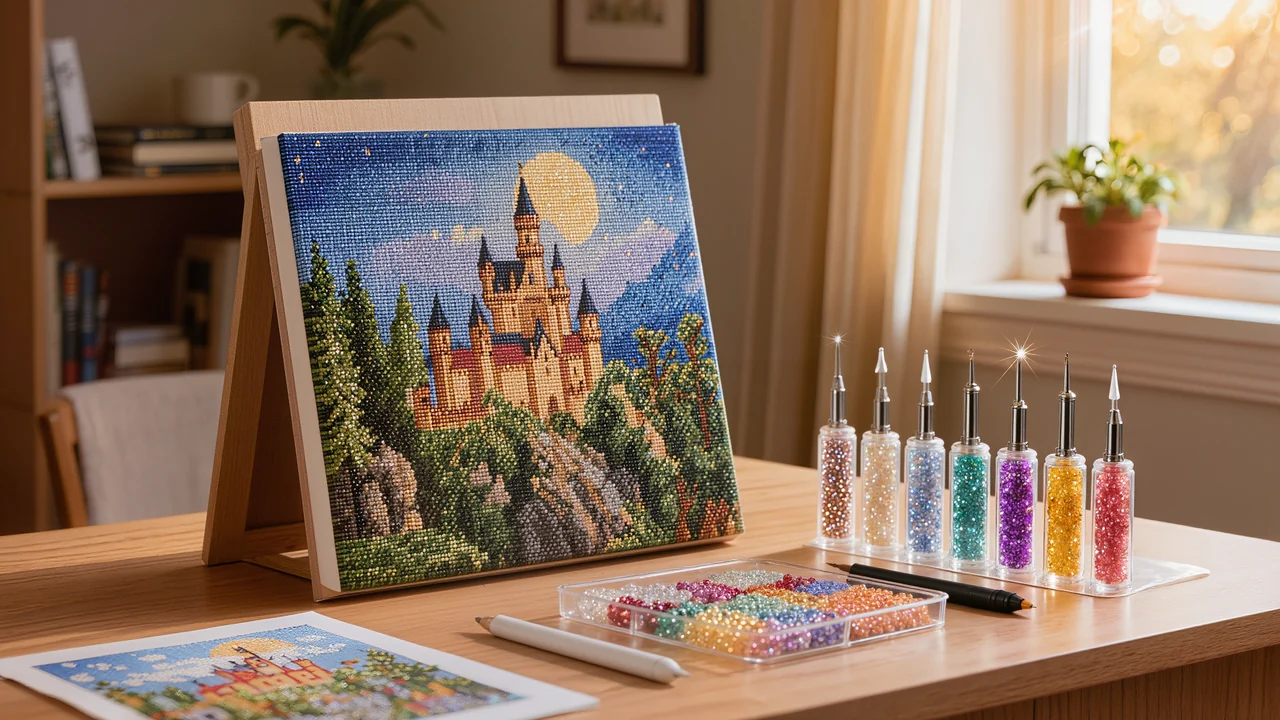
How to Frame Diamond Painting: Choosing and Fitting the Right Frame
To choose a frame for a diamond painting without crushing the beads, first measure the finished canvas, then check the available depth between the backing and the glass. A standard frame can work for a canvas in common dimensions; a shadow box or a glass-free mount leaves more relief and avoids pressure on the diamonds.
These tips are for beginners and enthusiasts alike who want to frame a finished or nearly finished piece. You will learn how to take the right measurements, tell the canvas size apart from the printed area, choose a solution that suits your budget, secure the work with confident handling, and find a spot where light, dust and cleaning will not damage it. A ruler and a soft cloth are often all you need to avoid a poorly fitting purchase.
In short
- A diamond painting canvas is thicker than a photo: you need a frame with at least 0.6 to 0.8 in (1.5 to 2 cm) of usable depth, or a shadow box frame.
- Always measure the stretched canvas, including the edges, and add the frame's allowance: never rely on the size of the printed design.
- Glass is not essential: a glass-free mount or open frame lets the facets sparkle and prevents condensation.
- A standard off-the-shelf frame works for most common sizes; custom framing is best reserved for unusual formats.
How to frame diamond painting: choosing the right frame
To choose a diamond painting frame without crushing the rhinestones, follow a simple rule: allow at least 0.6 to 0.8 inches (1.5 to 2 cm) of usable depth between the canvas surface and any glazing. Measure this thickness on a finished edge, diamonds included. A frame that is too shallow presses on the raised design, can loosen some stones and leaves visible marks after a few days.
For a flexible canvas, a standard frame works if its backing accepts the thickness of the support and if a slight margin holds the piece without squeezing it. A floating frame suits canvases mounted on stretcher bars: it leaves a small gap around the artwork and shows off its edges. In that case, keep the stretcher bars in place and choose an open-back model rather than a frame designed for a thin sheet. A glazing-free mount stays practical in a low-dust room, especially for a piece you plan to handle or change regularly.
Avoid glass placed directly against the diamonds. It creates distracting reflections, sometimes traps condensation between the adhesive surface and the glass, and then puts pressure on the raised areas. If you want to protect the canvas, pick a frame deep enough to leave an air gap and check that the glass stays clear of the stones. For a custom project, such as those in our Custom Diamond Painting Kits selection, it is worth checking this before buying the frame, because heavily detailed designs can have an uneven thickness.
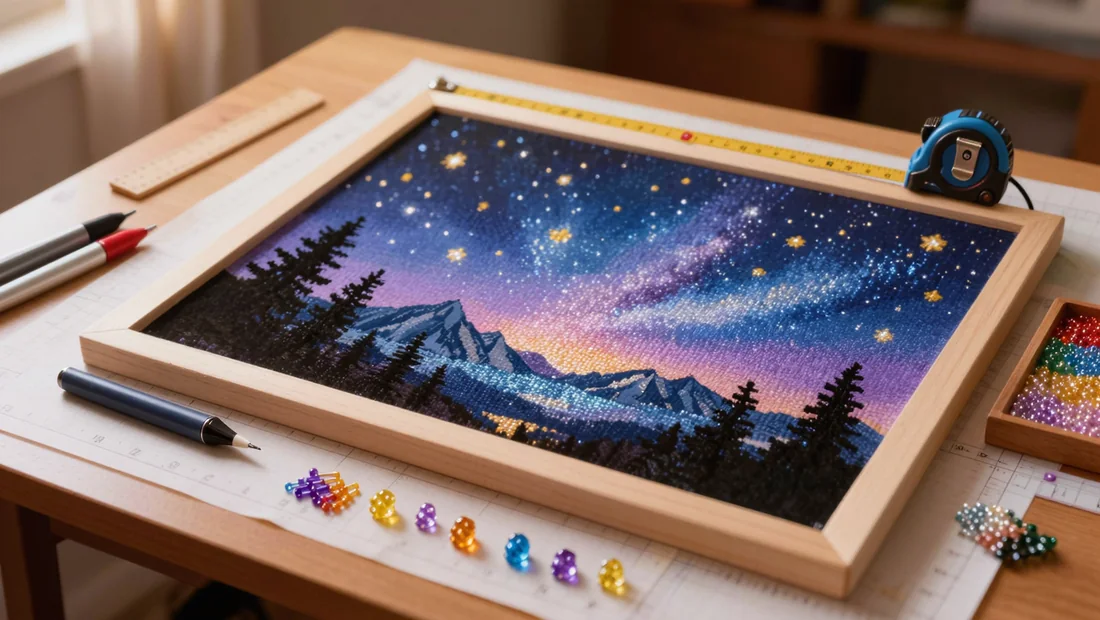
Measure your canvas before you buy: the method that prevents costly mistakes
Measure the outer edges
Lay the canvas flat, decorated side up, then measure the width and height from one outer edge to the other. Include the frame, the folded-over canvas and any staples that stick out. The printed design is not a reliable guide: it can leave a border of varying width.
Use a rigid tape measure or a metal ruler and record the dimensions in centimetres (and inches if you prefer). Write them down straight away on a piece of paper as "width × height".
Check the depth
Measure the thickness of the frame along the side, without pressing down on the canvas. Add the height of the diamonds, usually a few millimetres, to work out the space you actually need inside the frame. Allow another 2 to 3 mm (about 1/8 in) of clearance so the glass or backing does not touch the rhinestones.
Your notes should therefore include the width, height and depth of the frame. These measurements will also help you choose the essential diamond painting accessories.
Work out the frame allowance
Check whether the seller lists the internal opening dimensions or the outer border dimensions. For an internal opening, add the visible width of the frame on each side to estimate the final size: canvas width plus twice the border; do the same for the height.
Check the diagonal
Measure both diagonals, from one corner to the opposite corner. They should be almost identical. A difference of a few millimetres points to a warped canvas or a slightly distorted frame: flatten it before you buy the frame, otherwise the corners may pull on the diamonds.
Standard frame, shadow box or glassless mount: which one wins?
To choose how to frame diamond painting, start with three simple criteria: the size of the canvas, the look you want on the wall and how much you want to spend. A standard frame is often enough for a small stretched canvas. Larger pieces gain more presence in a shadow box, while a glassless mount shows off the resin facets to their best advantage.
| Option | Cost and fitting | Benefits | Choose it if… |
|---|---|---|---|
| Standard frame | The most affordable option and the quickest to find. | It suits small formats and protects the surface with glass. Allow enough depth so the diamonds do not touch the glass. | You want a classic finish that is easy to match with your furniture. |
| Shadow box | Usually a higher cost, and fitting requires the right hanging hardware. | Its interior space lets the canvas breathe and creates a visible border around the piece. The overall effect feels like a gallery display. | You are framing a large canvas or a custom creation, such as those offered in Custom Diamond Painting Kits. |
| Glassless mount | A simple solution, often inexpensive. | The facets catch the light directly and cleaning is quick with a soft duster. | The canvas is displayed in a low-dust room and you want maximum sparkle. |
| Custom frame | Worth it when the dimensions fall outside standard sizes. | The cut fits the canvas exactly and lets you choose the depth, colour and protection. | You are framing a matching set or several custom formats. Compare the quote with the price of essential diamond painting accessories. |
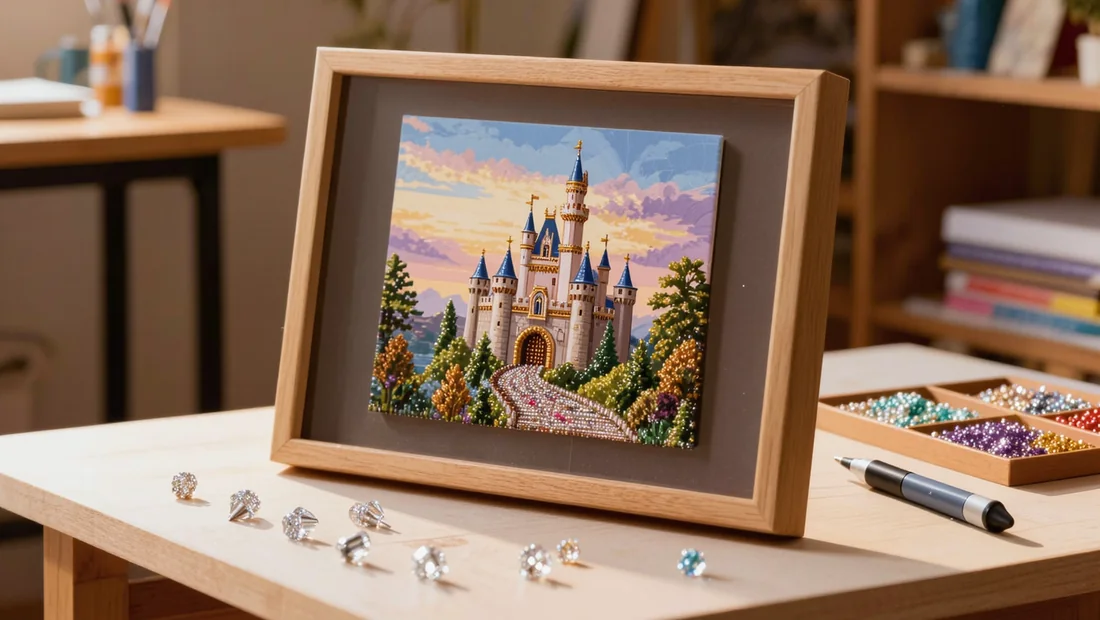
How to frame diamond painting without damaging the drills
Prepare the canvas
Lay your finished piece on a clean, clear table. Gently run your palm over the drills to check that none are lifting, then remove any dust with a soft brush.
Face the diamonds outwards
Position the canvas with the decorated side facing away from the frame. The drills should never be pressed against glass, acrylic or a solid backing board, as the raised surface can crush or dislodge them.
Centre without stretching
Place the canvas into the frame, lining up the edges with the sides. Adjust it with small movements, without pulling the canvas tight or pressing on the diamond-covered areas. Check the margins on all four sides before you continue.
Protect the edges
Cover the printed areas that extend beyond the frame with low-tack masking tape. This prevents a staple, clip or metal edge from rubbing against the drills during fixing.
Secure from the back
Use fasteners on the back of the frame, starting at the middle of each side and working towards the corners. Tighten just enough to hold the canvas: glue on the drills should be avoided, as it can dull their surface and make any future adjustments difficult.
Check for flatness
Turn the frame over and look at it from the side. If the canvas is slightly warped, place a clean piece of card on top, then a light, evenly distributed weight such as a book, and leave it overnight. Remove the weight afterwards and check that the diamonds are still clearly visible.
Where to hang your frame: light, wall and care
Once your frame is up, its position and how you care for it have a big impact on how well the colours hold and how much the drills sparkle.
- Choose a wall that gets little direct sunlight, as the rays can gradually alter the colours and yellow the resin of the diamonds.
- Keep the piece away from a radiator, a very exposed window and heat sources that cause temperature changes.
- Pick a dry, well-ventilated room, such as a living room or study, rather than a bathroom where steam can settle behind the frame.
- Before drilling, check that the wall will support the weight of the frame and choose a fixing suited to its type, using a wall plug if needed.
- Position the centre of the piece at eye level, usually around 1.5 m (about 5 ft) from the floor, then step back a few paces to check the alignment.
- For dusting, gently run a soft, dry cloth over the surface without pressing on the rows of diamonds.
- A clean, soft-bristled brush works well for the corners and raised areas of the frame, using light strokes from top to bottom.
- Avoid sprays, damp wipes and glass cleaners, which can leave a film on the resin or seep between the diamonds.
- Keep a cloth just for this purpose with your diamond painting accessories, so you avoid the greasy dust left by other fabrics.
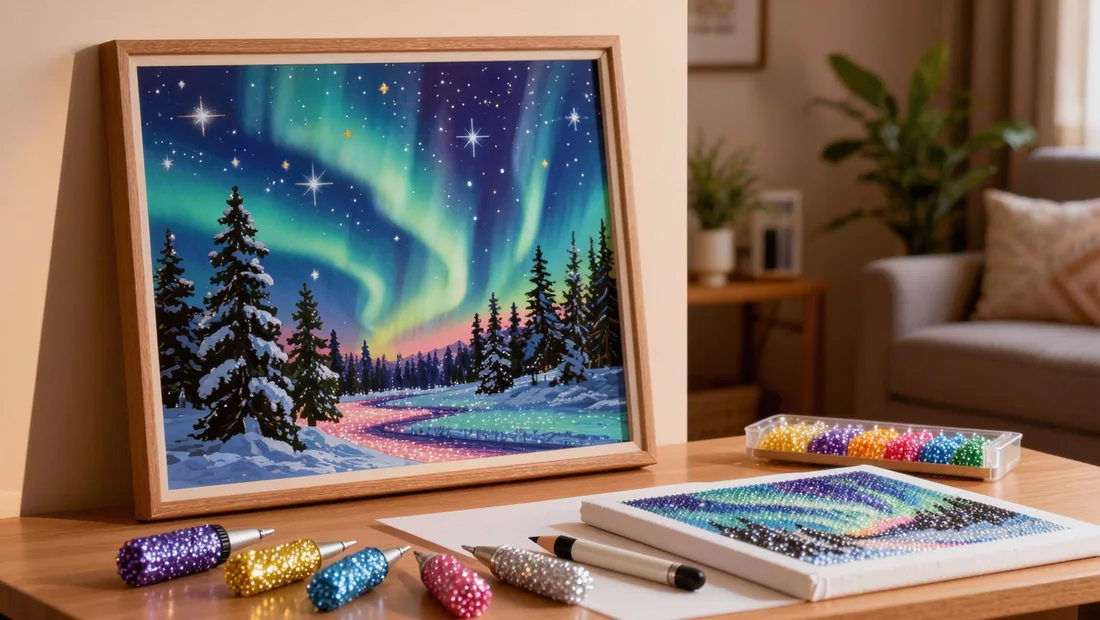
Which canvases really deserve a frame?
If your canvas has strong contrasts, a frame will give it a crisp presence on the wall. Large landscapes, night scenes and compositions with well-defined bright areas benefit from being protected and shown off, especially when they are worked on a large canvas. Landscape diamond painting kits often look particularly clear once they are stretched and framed.
Square formats fit easily into standard frame sizes. Panoramic formats sometimes need a less common size, but their horizontal composition works well on a wall above a sideboard or sofa. Before you buy, always check the measurements of the stretched canvas, then choose a frame whose rabbet fits its thickness properly without pressing on the drills.
A custom canvas deserves the same care. With a family photo, a pet or a holiday memory, a frame turns your work into a decorative piece you will be happy to keep or give away. A framed custom diamond painting is easier to preserve than a canvas left rolled up in its packaging. For a gift, have it framed before you hand it over: the person can hang it straight away, with no need to handle the diamonds or hunt for the right size.
Our picks



Measure your canvas while it is pulled taut, including the edges, then check that the frame offers at least 0.6 to 0.8 in (1.5 to 2 cm) of usable depth. Lay it flat, secure the back with tape or staples, and test the closure before tightening it for good. An open frame lets light play across the facets more effectively and helps prevent condensation. To find the right mount, see our must-have diamond painting accessories.
Your canvas is finished: give it the frame it deserves
Browse our high-definition stretched canvases, ready to frame, plus our accessories to finish your project neatly. Free tracked shipping, money-back guarantee.
View Diamond Painting Accessories & ToolsFrequently asked questions
Do you need glass on a framed diamond painting?
No, glass is not required to protect a framed canvas. The piece can stay open, which prevents glare and lets the facets catch the light. Condensation can also form between a pane and the rhinestones if air cannot circulate. A shadow box frame works well; simply dust the raised surface with care.
How deep should a frame be so it doesn't crush the diamonds?
Allow at least 0.6 to 0.8 inches (1.5 to 2 cm) of usable depth between the canvas and the front of the frame. This clearance keeps the rhinestones from touching glass, a mat, or the frame itself. Measure from the backing board to the highest point of the facets, then add a few millimetres of margin for a snug fit with no pressure.
How do you measure a stretched diamond painting canvas?
Measure the canvas once it is stretched and lying flat, including its edges right out to the ends of the backing. Then add the margin needed so the frame overlaps the border neatly. The size of the printed design is not a reliable reference: it often leaves a border that changes the final dimensions.
Can you frame a canvas without a stretcher frame?
Yes, a canvas without a stretcher frame can be framed once it has been stretched over a rigid backing. Use thick foam board or a lightweight panel, then secure the fabric at the back with conservation tape or a few staples. Check that the surface stays perfectly flat before placing it in the frame.
How do you clean a framed diamond painting?
Use a soft, dry cloth or a clean soft-bristled brush to remove dust from between the rhinestones. Work without pressing so you do not shift the facets. Avoid liquid products, wipes, and moisture: they can seep under the resin and weaken the adhesive. If glass protects the piece, clean it separately.
Related posts
 Butterfly Diamond Painting: Choose, Place, and Showcase Your Art
 Diamond Painting Stitch Guide: How to Choose the Right Kit
 Gondola Diamond Art Kit: How to Choose and Apply
 Christmas Diamond Painting Kits: How to Choose and Complete Your Canvas
 Storing diamond painting sealer sachets: the method that lasts